Tier 1 Bank Saves Over $10M Annually by Detecting Credit Card Fraud Rings with TigerGraph
The Challenge
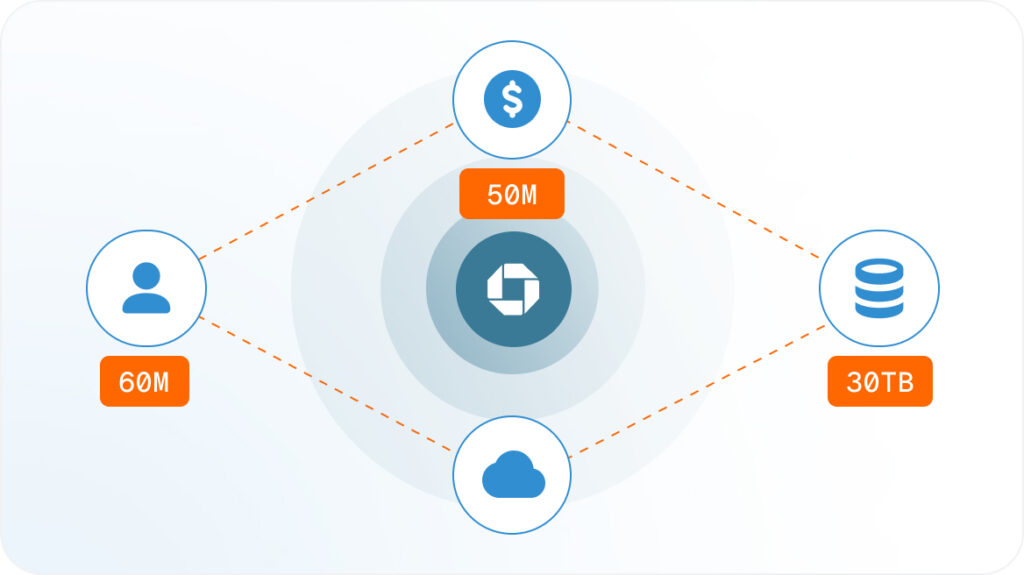
Existing fraud detection methods missed complex patterns, costing hundreds of millions annually. Legacy systems struggled with accuracy and couldn’t scale to handle 50M+ daily transactions under 80ms response time requirements.
The Solution
Implemented TigerGraph to connect six months of application data and identify relationships between known and unknown fraud. Graph analytics generated fraud-detection features for Tier 1 Bank’s machine learning system in less than 80 milliseconds.
The Results
Improved the accuracy and speed of fraud detection, saving Tier 1 Bank over $10M annually. Real-time graph analysis helps protect more than 60 million U.S. households while exposing organized fraud rings.
The Challenge
The Tier 1 Bank’s Consumer and Community Bank division wanted to improve its ability to identify fraudulent credit card applications. Individual fraud cases can be extremely difficult to detect because they provide few clues. But much of the fraud the Tier 1 Bank was targeting came from organized efforts in which groups repeatedly submitted fraudulent applications, creating relationships that could reveal otherwise hidden fraud rings.
The Tier 1 Bank needed to distinguish fraudulent applications from legitimate customers accurately and extremely quickly. Its analysis involved 10TB of raw data, with only a short window available to stop fraud while executing complex algorithms. Relational databases, NoSQL systems, and other graph databases had failed to solve the problem at the required speed and scale.
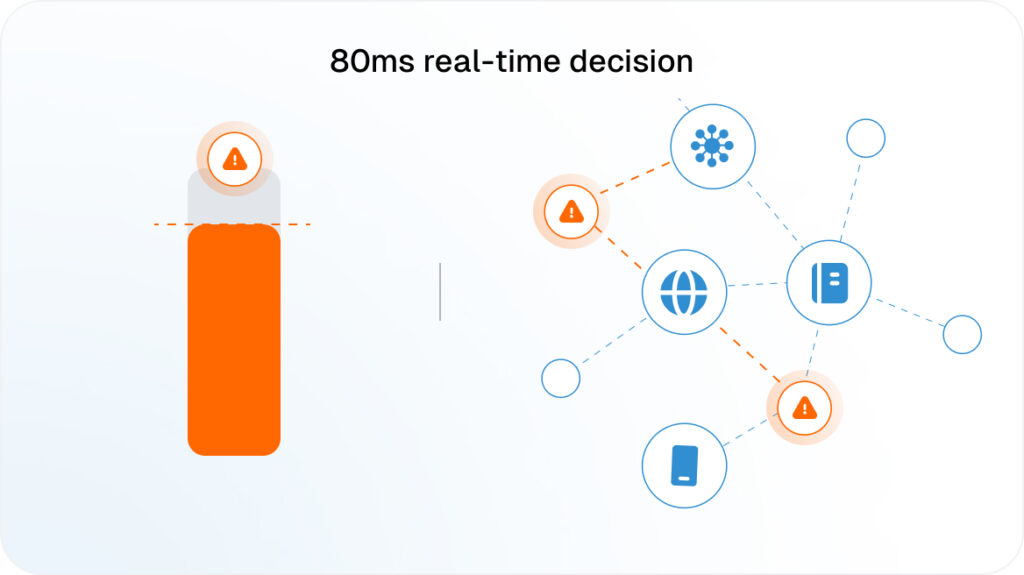
The performance requirements were stringent: graph queries needed to return in less than 80 milliseconds because TigerGraph represented only one component of the overall decision system. The Tier 1 Bank needed both the speed and scale to expose complex connections while supporting fast credit-card application decisions.
The Tier 1 Bank needed to distinguish fraudulent applications from legitimate customers accurately and extremely quickly. Its analysis involved 10TB of raw data, with only a short window available to stop fraud while executing complex algorithms. Relational databases, NoSQL systems, and other graph databases had failed to solve the problem at the required speed and scale.
The performance requirements were stringent: graph queries needed to return in less than 80 milliseconds because TigerGraph represented only one component of the overall decision system. The Tier 1 Bank needed both the speed and scale to expose complex connections while supporting fast credit-card application decisions.
The Solution
The Tier 1 Bank implemented TigerGraph to identify connections between known-fraud and unknown-fraud credit card applications, exposing organized fraud rings that were difficult to uncover using its previous database technologies. Six months of credit card application facts were represented as a graph containing applicant names, Social Security numbers, ZIP codes, phone numbers, application IDs, and known-fraudster status, with data updated incrementally each day.
Graph analytics enabled the Tier 1 Bank to traverse relationships surrounding applicants and known fraudsters, including shared identifying attributes and multi-hop connections. These graph-derived features were incorporated into the Tier 1 Bank’s machine learning system to improve the accuracy and speed of fraud detection.
To meet application volumes and performance requirements, the Tier 1 Bank operated six TigerGraph servers in parallel, each holding a complete copy of the application graph and providing redundancy if a server went down. TigerGraph’s REST endpoints ran the queries, which needed to complete in less than 80 milliseconds to fit within the overall fraud-decision time budget.
Graph analytics enabled the Tier 1 Bank to traverse relationships surrounding applicants and known fraudsters, including shared identifying attributes and multi-hop connections. These graph-derived features were incorporated into the Tier 1 Bank’s machine learning system to improve the accuracy and speed of fraud detection.
To meet application volumes and performance requirements, the Tier 1 Bank operated six TigerGraph servers in parallel, each holding a complete copy of the application graph and providing redundancy if a server went down. TigerGraph’s REST endpoints ran the queries, which needed to complete in less than 80 milliseconds to fit within the overall fraud-decision time budget.
The Results
Adding TigerGraph’s graph analytics to the Tier 1 Bank’s machine learning system delivered measurable financial impact. During the proof of concept, the Tier 1 Bank demonstrated more than $10 million in increased fraud avoidance, exceeding the original expectation of at least $5 million. In production, the graph features improved the accuracy and speed of fraud detection, saving the company over $10 million per year.
TigerGraph enabled the Tier 1 Bank to analyze complex relationships across 10TB of raw data while returning the required graph queries in less than 80 milliseconds. This combination of speed and scale allowed the bank to connect unknown applications to known fraud, identify organized fraud rings, and support rapid decisions on credit card applications.
The Tier 1 Bank’s Chief Information Officer for Consumer & Community Banking stated: “The speed and scalability of TigerGraph enable us to identify complex relationships from our rich data sets in real time”—helping the Tier 1 Bank protect more than 60 million U.S. households.
TigerGraph enabled the Tier 1 Bank to analyze complex relationships across 10TB of raw data while returning the required graph queries in less than 80 milliseconds. This combination of speed and scale allowed the bank to connect unknown applications to known fraud, identify organized fraud rings, and support rapid decisions on credit card applications.
The Tier 1 Bank’s Chief Information Officer for Consumer & Community Banking stated: “The speed and scalability of TigerGraph enable us to identify complex relationships from our rich data sets in real time”—helping the Tier 1 Bank protect more than 60 million U.S. households.
More stories
Fintech Customers
FinTell. Improving Risk Management for Banking and Fintech with Graph and Machine Learning
Fintech Customers
Intuit. Leveraging Knowledge Graphs to Accelerate Intuit’s AI Journey
Fintech Customers
Global Bank Saves $50M By Transforming Fraud Detection with Real-Time Graph Analytics